

In criminal proceedings, terms like “police custody” and “judicial custody” areoften used — yet many are unaware of their legal distinctions. Although both involve the restriction of personal liberty, they differ significantly in purpose, duration, and the rights available to the accused.
As Advocate Noor Yaqoob Shaikh, I regularly handle bail applications, remand hearings, and custody related matters in JMFC, Sessions, and High Courts. This article is intended to bring clarity and legal awareness for those confused about the difference between police and judicial custody — especially if you or a loved one is arrested.
What is Custody?
Custody refers to the condition of being detained by legal authorities, usually following an arrest. It is mainly of two kinds:
1. Police Custody – Where the suspect is detained by the police for investigation.
2. Judicial Custody – Where the suspect is sent to prison and is under the control of a court.
Both are controlled by Section 167 of the Code of Criminal Procedure (CrPC).
What is Police Custody?
After an arrest, a person may be taken into police custody for interrogation and investigation. In this case, the accused is detained at a police station lock-up and can be interrogated by the police under some safeguards.
Duration
- Max duration: 15 days
- Needs magistrate's permission
- If custody is required beyond 15 days, the accused is either sent to judicial custody or released on bail.
The accused has the right to be released on bail. JMFC (Judicial Magistrate First Class)
can grant bail immediately.
Purpose
- To obtain evidence or lawful confessions
- Recover stolen goods or arms
- Carry out identification parades
- Collect links with other suspects or offences
Rights During Police Custody
- Right to legal representation
- Right to silence
- Right to be taken before a magistrate within 24 hours (Article 22 of the Constitution)
- Right against torture and inhuman treatment
What is Judicial Custody?
Judicial custody refers to the accused being taken to jail (prison) by the court, not the police. The individual is held in a district or central jail, and the police may not access them without a court order.
Duration
- Up to 60 days for less serious crimes and 90 days for serious crimes (according to CrPC Section 167)
After this period, the accused is eligible for default bail if the charge sheet is not filed.
Purpose
- To prevent destruction of evidence by the accused
- To preserve public order
- To provide time to the prosecution to finish investigation
- To avoid pressure or threats to witnesses
Types of Jail Custody
- Undertrial prisoners – Waiting for trial or bail
- Convicted prisoners – Found guilty and serving their sentence (post-trial)
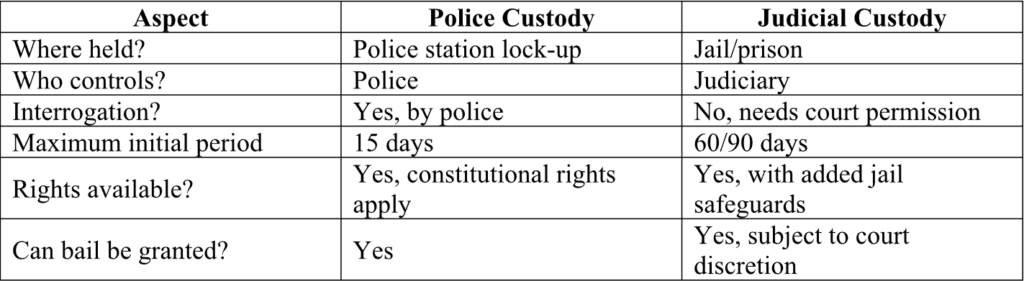
Key Differences Between Police Custody and Judicial Custody
Role of the Magistrate
A magistrate has a vital role in determining whether to grant judicial custody, police custody, or bail.
The magistrate is required to be satisfied that:
- There are reasonable grounds for detention
- The custody is not misused
- The rights of the accused are ensured
In many cases, courts may grant interim bail or directly remand the accused to judicial custody to prevent custodial abuse.
Important Legal Safeguards
- Right to be produced before a magistrate within 24 hours: Nobody is to be held for more than 24 hours without an order from a magistrate (Article 22).
- Right to legal aid: All accused are entitled to free legal aid.
- Right to medical examination: This is for the purpose of confirming whether or not the accused has been tortured.
- Right to silence: The accused is not obligated to respond to self-incriminating questions.
Role of the Magistrate
1. DK Basu vs State of West Bengal (1997)
Established elaborate guidelines to avoid police custodial torture and abuse.
2. CBI vs Anupam J Kulkarni (1992)
Made clear that police custody after the initial 15 days is not allowed.
3. State vs Dharampal (2003)
Held that even in judicial custody, police need court permission to interrogate further.
Conclusion
Understanding the difference between police custody and judicial custody is crucial if you or
your relative is arrested. Every phase carries specific legal consequences, and prompt legal action can safeguard your freedom as well as rights.
Don’t delay — consult Advocate Noor Yaqoob Shaikh, an experienced criminal defense lawyer, if you or your family member is involved in any custody-related matter. Timely legal action can protect your rights, challenge unlawful detention, and restore your freedom.