
- June 07, 2025
- 01
- 01

Judicial Separation Vs. Divorce: A Legal Outlook
Marriage is a special bond between two people, filled with love, care, and shared dreams. But sometimes, problems come up. Couples may argue a lot, feel unhappy, or grow apart. When this happens, they might not know what to do—should they stay together or separate?
If you’re uncertain about your marital path and considering legal separation but not yet ready for divorce, I’m here to help. I’m Advocate Noor Yaqoob Shaikh, a family law practitioner based in Pune. In this guide, I’ll walk you through your legal options — especially judicial separation — so you can make an informed and confident decision.
Many people think of divorce as the only solution. But divorce is a big step. It ends the marriage completely, and not everyone is ready for that. Some people still hope things can get better, or they don’t want to divorce because of family, religion, or personal reasons.
That’s why there is another option called judicial separation. This means a couple can live apart legally, without ending the marriage. It gives both people time and space to think about what they really want. It can also help keep things peaceful and fair while they are apart.
In this blog, we will explain what judicial separation is, how it is different from divorce, and how to choose the option that is best for you. If you’re going through a tough time in your marriage or helping someone who is, this guide will help you understand what you can do next.
What Is Judicial Separation?
Judicial separation is a legal agreement wherein a wedded couple chooses to live apart without terminating their marriage. Judicial separation doesn’t break the marital bond like divorce does; it merely provides both parties physical and emotional space to think, reconsider, or realign.
Most couples employ judicial separation as a means to experiment if they can reconcile. It also provides relief where religious, cultural, or emotional issues prohibit divorce.
In India, judicial separation is regulated under Section 10 of the Hindu Marriage Act, 1955, and is accessible to citizens of different faiths under different personal laws, including those getting married under the Special Marriage Act, 1954.
Judicial Separation vs. Divorce: Key Differences
Here’s a breakdown of the core differences to help you understand both options:
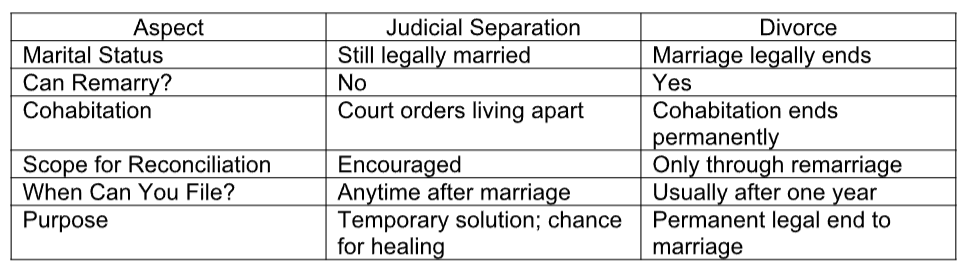
Judicial separation offers a gentler approach for couples who are uncertain about ending their relationship but still need space or protection—emotionally, legally, or physically.
When You Should Seek Judicial Separation?
Following are some real-life scenarios where judicial separation can be the next best step:
- You're feeling overwhelmed and need time apart to think clearly.
- You feel the marriage can be saved but require formal separation.
- Your cultural or religious views oppose divorce.
- You're experiencing emotional abuse or neglect and require legal separation.
- You wish to safeguard your rights without immediately dissolving the marriage.
Judicial separation offers legal structure, which may involve arrangements regarding
maintenance (financial provision), child custody, and residence—providing security that one partner isn’t left exposed.
Grounds for Judicial Separation in India
You may apply for judicial separation on the same reasons as divorce under Section 13 of
Hindu Marriage Act, 1955:
- Adultery – Your spouse has engaged in sexual intercourse outside the marriage.
- Cruelty – Physical or mental cruelty.
- Desertion – Your spouse has deserted you for two years or more without sufficient reason.
- Conversion – Your spouse converts to a different religion.
- Mental Disorder – Includes unsound mind or serious psychiatric illness.
- Venereal Disease – Contagious sexual disease.
- Renunciation – Your husband renounces worldly life.
- Not Heard Alive – Your husband has been missing for 7 years or more.
In women, other grounds are:
- Husband marrying more than one wife.
- Husband committing rape, sodomy, or bestiality.
- Such legal grounds make sure that separation is accessible when serious problems make living together dangerous or impossible.
Legal Consequences of Judicial Separation
After a court awards judicial separation, numerous changes occur:
1. Living Apart Becomes Legal :
You do not have to cohabit anymore. The court formally acknowledges your separation.
2. Financial Maintenance :
The court can order one of the partners to economically maintain the other, particularly if one cannot do for themselves.
3. Child Custody :
Legal provision may be made for the care, custody, and visiting of children.
4. Property Rights :
You both keep your legal rights to individual and joint property. A woman keeps her rights to stridhan (a woman’s personal property).
5. Sexual Consent and Safety :
If the husband coerces intercourse during judicial separation, it can be considered rape under Section 376B of the Indian Penal Code.
These protections are important for emotional health and legal protection during a separation period.
What Happens After Judicial Separation?
If the couple does not reunite and resume living together within a year from the order of
judicial separation, either of them can seek divorce under Section 13(1A) of the Hindu
Marriage Act.
Judicial separation can act as a stepping-stone to divorce if reconciliation is not feasible. But if the situation becomes better, the couple is always free to reconcile at any time and can resume the married life without any legal entanglement.
Judicial Separation: A Practical Example
Suppose Priya and Raj have been married for 5 years. It has been strained. They fight frequently, and Raj has begun staying out late. Priya feels emotionally abandoned but is not prepared to call off the marriage. She is concerned about her children, social reputation, and the permanence of divorce.Rather than taking the leap, she asks for judicial separation. They can live separately, the court tells Raj to pay maintenance, and gives temporary custody of the children to Priya. They spend the next year in counseling, thinking about their problems, and finally make up their minds to try again.If they had gone in for a divorce in the first place, it may not have been possible.
Conclusion
Every marital relationship is unique, and there is no universally applicable solution when it comes to legal separation or divorce. Judicial separation provides a structured opportunity for couples to reassess their relationship while maintaining the sanctity of marriage. It offers space for thoughtful consideration without requiring the finality of a divorce, allowing parties to make informed decisions about their future.
If you are experiencing uncertainty, emotional distress, or confusion regarding your marital situation, it is important to remember that you do not have to navigate this alone. While legal procedures may appear complex, they are designed to uphold your rights and safeguard your well-being.