
- June 07, 2025
- 01
- 01

If you or someone close to you is facing domestic abuse — whether physical, emotional, or financial — know that the law in India offers protection. You are not alone. The Protection of Women from Domestic Violence Act (PWDVA) was created to safeguard women like you and ensure legal remedies are accessible and effective.
Comprehending Domestic Violence in Relation to the Protection of women from Domestic Violence Act (PWDVA)
The Protection of women from Domestic Violence Act (PWDVA) has a broad definition of domestic violence that includes not just physical abuse, but also emotional, verbal, sexual, and economic abuse. The definition underscores the various types of violence that victims may suffer.
Types of Violence:
1.Physical Abuse: Actions inflicting pain or injury to a person’s body or threatening their life, health, or bodily safety.
2.Sexual Abuse: A woman is subjected to conduct of a sexual nature which, in the context of her gender, lowers or offends her dignity.
3.Verbal and Emotional Abuse: Verbal or emotional abuse includes physical or verbal insults, mockery, and other forms of humiliating treatment.
4.Economic Abuse: Condemning financial support, including income, monetary resources or access to work related tasks.
This Act applies to women who have been subjected to any form of domestic violence by a person with whom they have a domestic relationship.
What You Can Do If You Are Facing Domestic Violence:
- Contact a Protection Officer or your nearest police station immediately
- Reach out to a trusted lawyer or legal aid center for help in filing a complaint
- Document the abuse (messages, injuries, medical records, witness statements)
- Seek shelter or medical assistance if your safety is at risk
- Don’t hesitate to ask for help — legal support is your right, not a privilege
Legal Remedies Provided Under the Protection of Women from Domestic Violence Act (PWDVA)
1.Protection Orders: Granted by a Magistrate so that the abuser cannot commit other acts of violence, call or communicate with the victim, or visit the victim’s workplace or home.
2. Residence Orders: Secure the right of the victim to live in the joint household irrespective of title or ownership. The court can also order the respondent to vacate the joint household.
3. Monetary Relief: Payment for costs incurred as a result of domestic violence, such as medical bills, loss of earnings, and maintenance for the victim and her children.
4. Custody Orders: The respondent’s temporary custody of the children can be ordered to be given to the victim in order to ensure their safety and well-being.
5. Compensation Orders: Compensation can be ordered by the court for mental torture and emotional distress resulting from the actions of the respondent.
6. Counseling: The court can order the respondent or the parties to undergo counseling with a service provider.
7. Assistance of Welfare Experts: The court can seek the assistance of welfare experts to assist proceedings.
Role of Service Providers and Protection Officers
The Act requires the state government to appoint Protection Officers to help the victims obtain legal relief. Their role includes:
- Helping the victim in submitting complaints and applications for relief.
- Ensuring the victim is provided with medical assistance, shelter, and counseling.
- Offering information on legal aid and service providers.
The role of service providers such as NGOs and hospitals is also important in providing support services to the victims.
Filing a Complaint Under the Protection of Women from Domestic Violence Act (PWDVA)
Victims may file a complaint with a Protection Officer, police officer, service provider, or even to the Magistrate. The application must spell out the episodes of domestic violence and the reliefs claimed. The court is under an obligation to list the first hearing within three days from the receipt of the application and strive to dispose of the case within sixty days.
Recent Trends and Statistics Under the PWDVA (Protection of Women from Domestic Violence Act)
Understanding the impact of domestic violence also means looking at recent trends and statistics. Over the past five years, there has been noticeable activity in cases registered under the PWDVA. While these figures represent reported cases and may not capture every instance of abuse, they do offer insight into the scale of the issue and underscore the need for effective legal intervention.
Below is an illustrative table summarizing approximate case figures (based on government and official reports) over the last five years:
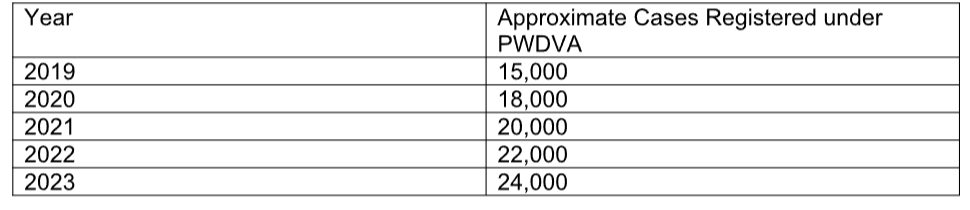
Note: These figures are indicative and reflect a trend of gradual increase, highlighting both improved awareness of legal rights and continuing challenges in addressing domestic violence.
Recent years have seen a rise in reported cases, a trend that may be attributed to greater awareness, better reporting mechanisms, and more active intervention by support agencies and legal institutions. However, this increase also points to a persistent problem that demands ongoing attention and robust legal protection.
Real-Life Cases
Case 1: Bhopal Dowry Harassment Leading to Murder
In Bhopal, a man named Dinesh Ahirwar was arrested for allegedly murdering his wife, Sharda Ahirwar, following continuous dowry harassment. The incident occurred in April 2025, and the couple’s five-year-old daughter witnessed the crime.
Case 2: Chennai Court Awards Compensation for Sustained Abuse
A Chennai city court awarded ₹5 lakh in compensation to a woman who endured sustained abuse and stalking by her husband and in-laws during and after a brief marriage. The court recognized the enduring impact of the abuse and issued restraining orders against the perpetrators.
Case 3: Ahmedabad Court Grants Maintenance Despite Divorce
An Ahmedabad court ruled that an NRI must pay his ex-wife ₹40,000 in monthly maintenance, ₹20,000 as house rent, and ₹25 lakh in compensation under the Domestic Violence Act, despite their divorce being granted on grounds of adultery and cruelty.
Challenges in Implementation:
Even with the elaborate framework, the enforcement of the Protection of Women from Domestic Violence Act (PWDVA) suffers from a number of challenges:
- Lack of Awareness: Victims are not aware of their rights and the remedies that they can avail under the Act
- Inadequate Infrastructure: Deficiency of Protection Officers, shelter homes, and counseling centers is inhibiting effective assistance.
- Societal Stigma: Victims tend to suffer from societal pressure and stigma, deterring them from approaching courts of law for redressal.
- Delayed Judicial Process: Congested courts and procedural delays can cause delays in relief.
- You wish to safeguard your rights without immediately dissolving the marriage.
Steps to Take If You Are Facing Domestic Violence
If you or someone you know is experiencing domestic violence, it is critical to act quickly. Here are the key steps you should consider:
- Seek Immediate Safety: If you are in immediate danger, contact the police without delay. Your safety is the first priority.
- Consult a Legal Professional: Get in touch with a trusted lawyer. Professional guidance is essential to navigate the legal procedures and to file for protection under the PWDVA.
- Document Evidence: Keep detailed records of all incidents of abuse. Collect photographs, medical reports, and witness statements to support your case.
- File a Complaint: Approach the police, a Protection Officer, or the local court to file a formal complaint under the PWDVA. Prompt action can prevent further harm and initiate legal proceedings to protect your rights.
- Explore Support Services: Reach out to counseling services and support groups. Emotional and psychological support is just as important as legal remedies in your recovery.
- Monitor Court Proceedings: Stay informed about the progress of your case and maintain regular contact with your legal counsel to ensure that all court orders (protection, residence, monetary relief) are effectively enforced.
Conclusion
The Protection of Women from Domestic Violence Act, 2005, is an important legislative step towards protecting women’s rights and giving them legal recourse against domestic violence. Legal protection is your right — and the law is on your side. If you’re in a situation of domestic violence, take the first step toward reclaiming your safety and dignity.
As Advocate Noor Yaqoob Shaikh, I am committed to supporting women through every stage of the legal process — with compassion, confidentiality, and strength. Whether you are a victim seeking relief or someone trying to help a loved one, I offer a safe space and strong legal representation to help you reclaim control over your life.