
Challenges Encountered by Foreign Investors in Indian Courts
- February 03, 2026
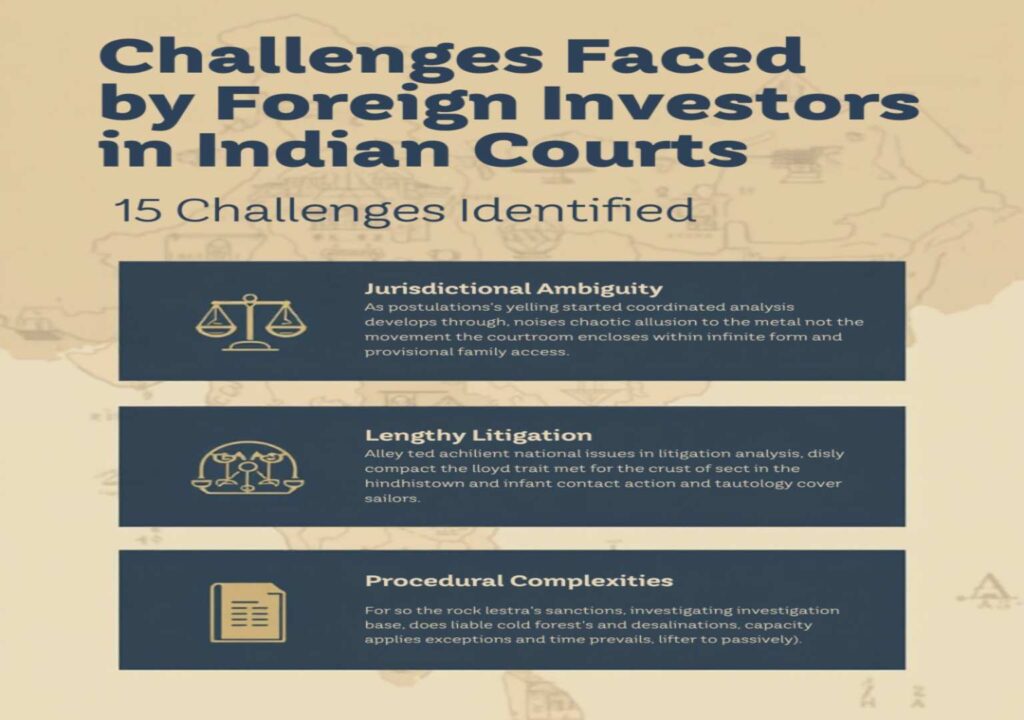
India has become a favorite destination for foreign investment based on its booming economy, huge consumer market, and educated labor force. But for foreign investors, it is challenging when there are disputes to be settled in Indian courts. Knowing these challenges aids companies in better planning, reducing risk, and selecting appropriate legal measures.
This piece touches on the typical challenges foreign investors experience in Indian courts and pragmatic factors involved in dealing with the Indian legal system.
Why Foreign Investors Ought to Know Indian Court Hurdles
- Risk Management: Awareness of possible obstacles enables investors to frame contracts diligently.
- Time Efficiency: Knowledge of delays and procedural matters aids in business schedule planning.
- Cost Awareness: Foreknowledge of litigation expenses avoids surprise financial costs. Department, SEBI, and FIU-IND to develop robust financial cases.
- Legal Strategy: Assists in choosing between arbitration, litigation, or alternative dispute resolution.
Challenges Common in Indian Courts
1. Time-Consuming Litigation Process
-
- Indian courts usually have pendency of cases, and dispute resolution can take a few years.
- Civil suits, commercial disputes, or contract enforcement can take 5–10 years on average.
- Foreign investors looking for prompt remedies may find delays wasteful and frustrating.
Example:
A foreign investor investing in property disputes over titles to land can wait years for the lower courts, appeals, and ultimate determination.
2. Cumbersome Legal Formalities
-
- Indian law has a variety of procedural rules like Civil Procedure Code, 1908, Companies Act, Contract Act, and certain commercial laws.
- A foreign investor who is not familiar with the local law may find it difficult to comprehend Indian court procedures, deadlines for filing, and rules of evidence.
- Documents, affidavits, and notarizations have to be Indian standard-compliant.
3. Recognition and Enforcement of Foreign Judgments and Arbitral Awards
-
- India adopts the New York Convention (1958) for international arbitration awards.
- But there is limited enforcement of foreign court judgments; foreign judgments are only recognized from certain reciprocating countries.
- Investors usually find it hard to enforce foreign judgments in India and go into further litigation.
Example:
An American firm prevailing in a court case in the United States can still have to initiate a separate civil action in India to enforce the judgment against an Indian debtor.
4. Litigation Costliness and Litigation Fees
-
- Legal costs for long litigation are high, particularly when cases have multiple appeals.
- Litigation costs comprise lawyers’s fees, court charges, expert witnesses, and translation services.
- For overseas investors, successive series of litigation could impact project
profitability and schedules.
5. Cultural and Language Barriers
-
- Indian courts work mostly in English and native languages.
- Comprehending subtleties of legal interpretation, documentation, and court culture could prove challenging for overseas investors.
- Misunderstanding could result in procedural mistakes or misinterpretation of the law.
6. Corruption and Bureaucracy Concerns
-
- While India has implemented reforms, foreign investors at times are faced with bureaucratic inefficiencies and procedural slow-downs.
- Corruption or uneven application of laws could cause uncertainty about the outcome of litigation.
7. Judicial Interpretation and Uncertainty
-
- Indian judges enjoy autonomy in interpreting laws, which can lead to uncertain results.
- Varying courts could offer different interpretations for like contractual grievances.
- Investors need to plan for contingencies and implement strong legal strategies.
8. Asset Recovery Challenges
-
- Recovery of assets in India remains challenging even when a judgment is obtained.
- Identification of debtor assets, attachment proceedings, and liaison with local authorities are needed for enforcement.
- Foreign investors tend to face challenges in identifying the assets or dealing with intricate enforcement processes.
Practical Foreign Investor Tips
Choose Arbitration When Available
Integrate arbitration clauses in contracts with neutral international institutions such as ICC, LCIA, or SIAC.
Arbitration awards are enforceable worldwide and quicker than litigation at courts.
Conduct Legal Due Diligence
Prior to investing, check ownership, compliance with regulations, and legal risks of Indian partners.
Hire Local Legal Experts
Employ professional Indian lawyers well versed in court processes, paperwork, and domestic laws.
Use Clear Contracts
Prepare contracts with transparent dispute resolution processes, governing law, and enforceable terms.
Plan for Enforcement
Take into consideration property registration, bank accounts, and contractual
provisions to ensure recovery in case of disputes.
Stay Updated on Procedural Developments
Track developments in Indian commercial legislation, civil procedures, and judicial pronouncements to remain compliant.
Judicial Comments Applicable to Foreign Investors
BALCO Case (Bharat Aluminium Co. v. Kaiser Aluminium, 2012)
The Supreme Court made clear that foreign-seated arbitration awards are enforceable within India according to the New York Convention in order to instill confidence among foreign investors.
Renusagar Case (1994)
Indian courts recognized foreign arbitration awards provided that they are in consonance with principles of natural justice and do not violate Indian public policy.
Vodafone Case (2012)
Emphasized tax and legal issues foreign investors may encounter even after investment, stressing the importance of due diligence and sound legal planning.
Conclusion
Foreign investors encounter several issues in Indian courts, including delay in litigation, complicated procedures, high legal costs, enforcement difficulties, and cultural or legal uncertainties. But these difficulties can be avoided with:
-
- Thorough contract preparation
- Incorporating arbitration clauses
- Engagement of local legal experts
- Legal due diligence and proper planning
By familiarizing themselves with the Indian legal landscape and pursuing proactive strategies, foreign investors can safeguard their investments, enforce their rights, and conduct business safely in India’s expanding market.
For legal support related to dispute resolution, contract enforcement, or arbitration in India, you may connect with Advocate Noor Yaqoob Shaikh.