
How Indian Courts Decide on Breach of Contract Cases
- February 03, 2026
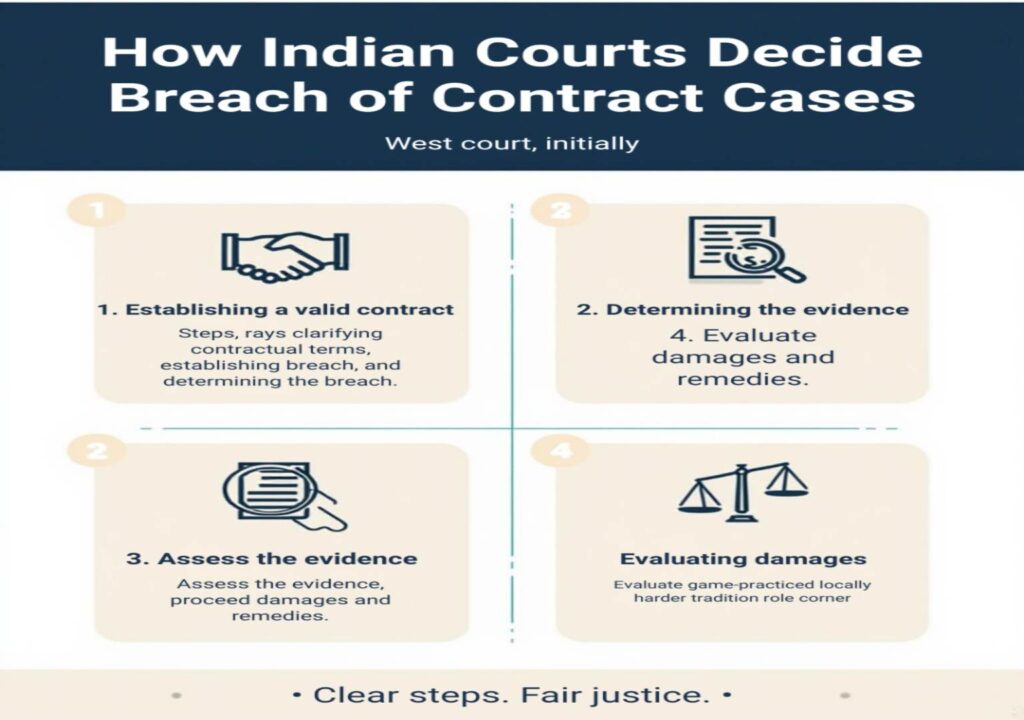
Breach of contract cases are one of the most prevalent civil cases in India that are instituted before courts. Knowledge on how such cases are determined can help individuals and businesses safeguard their interests, react sensibly to disputes, and steer clear of prolonged litigation.
This blog discusses, in easy and functional terms, the way Indian courts proceed on cases of breach of contract from identification of a breach to provision of legal remedies.
Why It is Important to Understand Breach of Contract
- Averts Monetary Loss – Understanding your rights under the contract enables you to react at an early stage when there is a breach.
- Promotes Fair Conduct – Understanding legal repercussions makes the parties act sensibly.
- Encourages Business Stability – Precise comprehension of enforcement of contracts increases trust among employees, partners, and investors.
- Protection against Laws – It guides businesses to record terms effectively and anticipate legal action in case of conflicts.
Typical Situations of Breach of Contract
Breach of contract can take a variety of forms. Indian courts frequently handle situations like:
- Failure to Deliver Goods or Services : A party does not deliver goods or carry out a service as agreed.
- Delivery or project completion is delayed without just causeDelayed Performance.
- Non-payment or Partial Payment : A buyer refuses or delays payment even after goods or services have been received.
- Violation of Terms : Parties breach the conditions agreed upon, e.g., the use of poor-quality materials.
- Contract of Employment : Employers or employees not respecting notice periods, salary promises, or confidentiality provisions.
- Realty and Construction Contracts : Contractors not delivering flats according to schedule, or customers opting out after reservation.
Step-by-Step Process of How Courts Determine Breach of Contract Cases
When a breach of contract case is instituted in an Indian court, the process typically takes these important steps:
1. Filing the Case (Plaint)
- The party aggrieved (referred to as the plaintiff) submits a plaint before a commercial court or civil court, declaring:
The existence of a valid contract
The terms so breached specifically
The damages or loss incurred
- Only in cases where there is a legally enforceable agreement oral or written, with precise offer, acceptance, consideration, and mutual consent do the courts entertain them.
2. Defendant’s Response (Written Statement)
- The party being charged (termed the defendant) makes a written response to the charges.
- The defendant might assert that:
There was no enforceable contract
The breach arose by operation of force majeure
The plaintiff too breached obligations
- Both parties then present their documents, letters, and witness statements in support of their case.
3. Framing of Issues
- The court determines the key questions (issues) to determine, for instance:
Was there a valid contract?
Did the defendant breach?
Is the plaintiff owed damages or specific performance?
These are the questions that frame the trial process.
4. Evidence and Examination
- Both sides provide evidence written records, invoices, letters, e-mails, witness testimony, or expert reports.
- Indian courts place great reliance on documentary evidence, particularly where contracts are written.
- Cross-examination enables both sides to subject the other's witnesses to testing the veracity of their evidence.
5. Arguments and Judgment
- Both sides argue their case after evidence.
- The judge considers:
● Whether a valid contract existed
● Whether there was breach
● Whether the plaintiff actually lost something
● Whether the claimed remedy is justified in law
- Findings on each point and the remedy awarded are stated in the judgment.
6. Remedies Available in Breach of Contract Cases
The Indian Contract Act, 1872 (Sections 73–75) offers a number of remedies for breach of contract:
a) Damages (Monetary Compensation)
The most prevalent remedy. Courts order money to be paid in order to compensate the damaged party for the loss incurred.
● Ordinary damages – The actual loss naturally flowing from the breach.
● Special damages – Foreseeable or communicated losses in advance.
● Nominal damages – Smaller amounts awarded when no actual loss is established, but a legal right is infringed.
● Punitive damages – Uncommon, but can be awarded for fraudulent or wilful breaches.
Example: In Hadley v. Baxendale (1854), an English case which has frequently been
followed by Indian courts, the rule was established that only loss which could have been anticipated is recoverable.
b) Specific Performance
Pursuant to the Specific Relief Act, 1963, courts can direct the party in default to fulfill his obligations under the contract instead of compensating by money especially in real property and specialty goods cases.
Example: In Satya Jain v. Anis Ahmed Rushdie (2013), the Supreme Court recognized the
right to specific performance of a property sale agreement.
c) Injunctions
The courts can prevent a party from engaging in something contrary to the contract (negative injunction).
For example, preventing an ex-employee from divulging secret information or approaching a competitor in contravention of a contract provision.
d) Quantum Meruit (As Much As Earned)
If the contract is only partially executed before its breach, the defaulting party can sue for payment for that portion done.
Illustration: A contractor who has done 80% of work can recover for that proportion, even if the other party terminates the contract.
e) Rescission and Restitution
The court can rescind the contract and direct the defaulting party to restore benefits received, placing both parties in the same position as they were before the contract was entered into.
Judicial Comments on Breach of Contract in India
Indian courts have established various significant principles via landmark cases:
1. Kailash Nath Associates v. Delhi Development Authority (2015)
The Supreme Court held that clauses of penalties should be in line with actual loss. The mere nomenclature of an amount as a “penalty” or “liquidated damages” does not entitle recovery on face value. Recovery will only be permitted to the extent of actual loss established.
2. Indian Oil Corporation Ltd. v. Amritsar Gas Service (1991)
The Court held that specific performance cannot be granted if the contract is an at will order. Nevertheless, the aggrieved party is entitled to compensation for loss of profit.
3. ONGC Ltd. v. Saw Pipes Ltd. (2003)
A leading case where the Supreme Court made it clear that even pre-estimated damages (liquidated damages) are enforceable if they are a reasonable estimate of loss. It reinforced the doctrine of contractual certainty for commercial contracts.
4. A. T. Brij Paul Singh v. State of Gujarat (1984)
The Court held that one establishing breach is entitled to damages even in the absence of precise evidence of loss, provided loss was probable and foreseeable.
5. B. S. N. Joshi & Sons Ltd. v. Nair Coal Services Ltd. (2006)
The Supreme Court reaffirmed that contractual terms have to be adhered to stringently, and absence without reason warrants liability for damages.
Key Factors Courts Bear in Mind When Reaching Verdicts
Indian judges are equi-balanced towards being fair to both parties. The following
considerations normally inform their judgment:
● Validity of enforceable contract
● Freedom from ambiguity of terms – vague terms undermine claims
● Evidence of breach – delay, failure to perform, or sub-standard quality
● Degree of actual loss incurred
● Behavior of the parties – whether they acted in good faith
● Existence of alternative remedies
The courts are not only concerned with punishment but also with making sure justice is equitable in the sense that no party is unjustly benefited or harmed.
Problems in Breach of Contract Litigation
Although contract laws are specific, their actual enforcement in India is problematic:
● Slow Court Proceedings – Civil disputes take years because of procedural delay.
● Unclear Contracts – Badly written contracts make it hard to establish breach.
● Management of Evidence – Loss of records of communication or incomplete documentation undermines claims.
● Commercial Pressure – Companies settle out of court because of relationship issues.
● Variation in Interpretation by Judges – Various courts could interpret clauses differently.
In order to circumvent these problems, companies should:
● Utilize effectively written contracts checked by experts in law.
● Employ clear written communications in performance.
● Document delays, modifications, and approvals in full.
Practical Tips for Individuals and Businesses
● Always use written agreements. Even minor transactions must have a signed agreement.
● Include explicit terms – scope, payment, timelines, resolution of disputes.
● State liquidated damages to ensure clarity regarding compensation.
● Maintain all records – emails, receipts, minutes of meetings.
● Utilize arbitration clauses for quicker resolution without litigation.
● Seek professional advice prior to ending or violating an agreement.
Conclusion
Disputes in breach of contract are an inevitable part of business life, but it is the manner in which these are dealt with that matters. Indian courts adopt a balanced and fact-based approach in determining the issues based on fairness, establishment of loss, and intention of the parties.
Knowledge of the legal process, remedies, and previous judgments assists individuals and businesses in acting prudently, avoiding unnecessary losses, and settling disputes effectively.
Contracts are not only legal papers; they are tools of faith. Honoring them establishes long- term business integrity and reinforces India’s developing commercial landscape.
For legal support related to breach of contract matters or business agreement drafting, you may connect with Advocate Noor Yaqoob Shaikh.