
Second Marriage and Legal Consequences Under Indian Law
- February 04, 2026
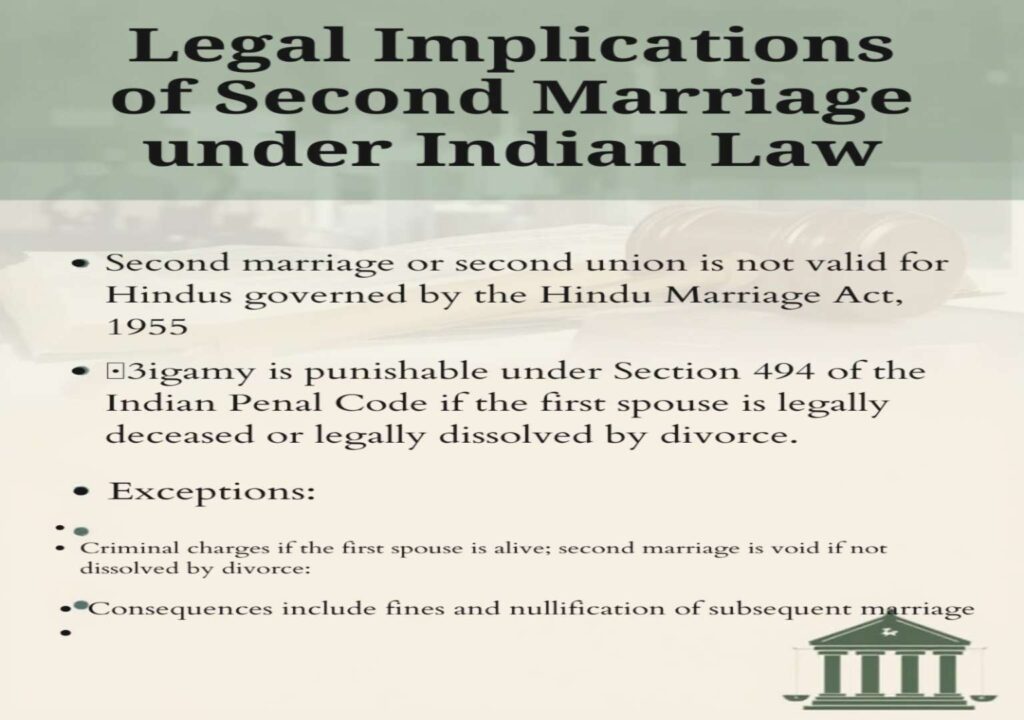
Marriage in India is not only an individual union but also a legal and social institution that is safeguarded by numerous laws. Although remarriage or second marriage can be considered a personal decision, it has grave legal repercussions if not carried out following the law. In India, numerous individuals unwittingly engage in second marriage without fulfilling the legal procedures of the first one, leading to criminal offenses, social discredit, and psychological discomfort.
This article explains how Indian law treats second marriages, what steps must be followed to make them legally valid, and the penalties for unlawful remarriage.
Why Understanding Legal Rules for Second Marriage Is Important
- Legal Protection: Knowing the law prevents a person from committing bigamy, which is a punishable offence in India.
- Security for Both Partners: Protects the rights of both spouses and guards them against financial and emotional exploitation.
- Religious Compliance: Every personal law in India—Hindu, Muslim, Christian, or Parsi prescribes varying provisions for remarriage.
- Social Stability: Compliance with due process encourages trust, respect, and cooperation within society and family.
Common Scenarios of Second Marriage Disputes
- A husband or wife remaries without obtaining a valid divorce decree from court.
- Misleading information concerning marital status is provided prior to remarriage.
- Concealment of marriage during the pendency of the first marriage.
- Muddle between customary separation and judicial divorce.
- Conflicts concerning legitimacy and right of inheritance of children born out of the second marriage.
Legal Framework Regulating Second Marriage
Hindu Marriage Act, 1955
- Section 5 explicitly mentions that a valid marriage can only be conducted if neither of the parties has a living spouse when they get married.
- Section 11 states that any marriage conducted while a spouse is alive is void.
- Section 17 criminalizes bigamy as an offence under Section 494 of the Indian Penal Code (IPC).
Indian Penal Code, 1860
- Section 494: Bigamy is an offense when a person marries again during the
subsistence of a valid spouse. Punishment: imprisonment for a term not exceeding
seven years and fine. - Section 495: When a person keeps their previous marriage a secret and remarries,
the punishment can be up to ten years and fine.
Muslim Personal Law
- A man can have four wives simultaneously, but only if he keeps them equally and just, under Muslim law.
- Muslim women are not allowed to have more than one husband simultaneously.
Christian Marriage Act, 1872 & Divorce Act, 1869
- A Christian individual may remarry only after a decree of dissolution or nullity is granted by a competent court.
Special Marriage Act, 1954
- Section 4 provides that neither of the parties must have a living spouse at the time of marriage.
- Contravention of this condition renders the marriage void and punishable under the provisions of IPC.
Step-by-Step Legal Process Before a Second Marriage
Get a Certified Divorce Decree:
The initial step is to confirm that the prior marriage has been lawfully dissolved by a
competent court via a decree of divorce or annulment. Verbal separations and personal
agreements are not accepted in law.
Wait for Appeal Period to Expire:
Once the divorce decree is approved, there is generally a 90-day time limit for filing an
appeal. It is advisable to wait until this time is over to prevent any legal issues in case of an appeal being filed.
Gather All Documents Involved:
Have copies of the divorce decree, marriage certificate, and proof of identity ready prior to filing the new marriage.
Marriage Registration
The second marriage must be registered under the applicable personal law or the Special
Marriage Act for legal approval and evidence.
Inform Family and Legal Authorities (if required):
Being open avoids future accusations of fraud or concealment of facts.
Seek Legal Advice:
Taking legal advice prior to remarriage ensures all the formalities are done and safeguards against future legal consequences.
Judicial Observations on Second Marriage
Sarla Mudgal v. Union of India (1995)
The Supreme Court held that a Hindu husband who converts to Islam and re-marries without annulling his initial marriage commits bigamy. The Court reasserted that conversion cannot be utilized as a device to avoid monogamy statutes.
Lily Thomas v. Union of India (2000)
The Court held that even if the first marriage subsists, the second marriage would be void under Section 494 IPC.
Yamunabai Anantrao Adhav v. Anantrao Shivram Adhav (1988)
The Supreme Court ruled that a woman who enters into wedlock with a man who already has a living wife is not a “wife” in law and can’t claim maintenance under Section 125 CrPC.
Reema Aggarwal v. Anupam (2004)
The Court noted that although the second wife might not be a "lawful wife" in the legal sense, she can approach courts under legislation against cruelty and domestic violence.
Practical Problems in Cases of Second Marriage
- Spurious Divorce Papers: At times, people produce false documents in order to remarry, which could eventually result in criminal prosecution.
- Social Pressure: Stigma fear can compel people to conceal details of previous marriages.
- Religious Conversions: Religious conversions for the sake of remarriage are causing legal disputes.
- Property Disputes: Second-married children could have issues inheriting property rights.
- Delay in Court Cases: Divorce and annulment cases take years, hindering plans for remarriage.
- Abuse of Law: False cases of bigamy are filed sometimes out of revenge or ignorance.
Illegal Second Marriage Consequences
- Criminal Responsibility: Bigamy carries imprisonment of up to seven years under Section 494 IPC.
- Void Marraige: Second marriage is legally non-existent and cannot be enforced against anybody in court.
- Loss of Rights over Property and Maintenance: Second spouse cannot claim maintenance, inheritance, or marital benefits.
- Psychological and Social Consequences: Families and children end up having long- term, far-reaching consequences, such as trauma and stigma.
- Chance of Divorce or Annulment: The second marriage may legally be annulled by court on finding of a subsisting marriage.
Conclusion
Second marriage in India is not just an emotional or individual decision—it has serious legal ramifications if done without the law. Prior to embarking on a new relationship, there is a requirement that the earlier marriage has been legally dissolved by a valid court order. This provides safeguards to all concerned and avoids unnecessary criminal prosecution.
Marriage is an emotional and legal tie. Knowing its legal structure assists people in making mature decisions and ensures impartiality, respect, and harmony in society.
For legal support on divorce, annulment, or remarriage matters, you may connect with Advocate Noor Yaqoob Shaikh.