
How NBFCs Can Legally Recover Defaulted Loans
- February 8 , 2026
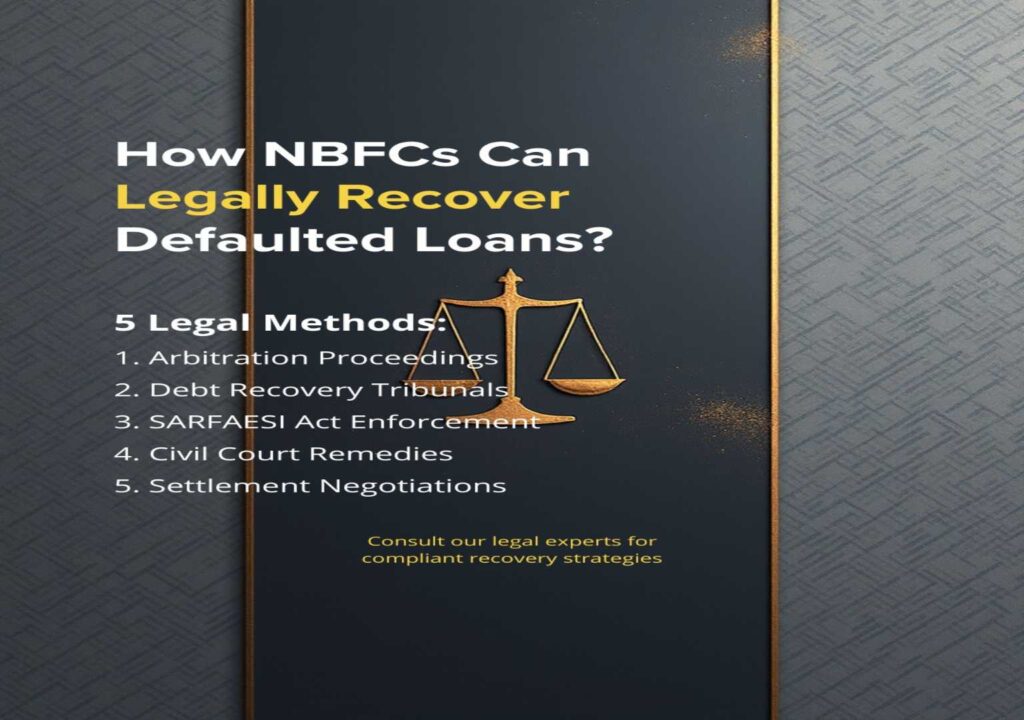
NBFCs are crucial contributors to the credit ecosystem in India, with loans being extended across segments such as MSMEs, housing, vehicle loans, education, and consumer finance. The challenge comes with rapid loan expansion, which leads directly to loan defaults, thereby impacting liquidity and financial stability.
Indian law thus offers several legal and procedural means for recovery to NBFCs in order to maintain credit discipline. This blog explains how NBFCs can legally recover defaulted loans, the statutory powers available to them, and the steps to ensure compliance with regulatory norms.
Why Proper Recovery Mechanisms Are Important for NBFCs
Defaults on loans have far-reaching consequences beyond financial statements. They affect:
- Cash flow and liquidity
- Ability to lend further
- Borrower discipline
- Investor and lender confidence
Courts have noted that “credit institutions must rely on structured and lawful recovery mechanisms to maintain stability in the financial system.”
Legal Routes Available to NBFCs for Loan Recovery
NBFCs have many legitimate options, depending on loan amount, type of security, and borrower profile.
- Issuing a Legal Demand Notice
The initiation in the process of recovery normally starts with a demand notice, which apprises the borrower about:
- Outstanding dues
- Interest and penalties
- Time given for repayment
- Consequences of Non-Payment
NBFCs shall adopt fair communication policies to counter any complaints of harassment.
- SARFAESI Act (For Eligible NBFCs)
SARFAESI Act, 2002, can be invoked only by eligible NBFCs, i.e., notified by RBI and having qualifying asset size and security cover. It is allowed to:
Benefits available to NBFCs under SARFAESI
- Taking possession of secured assets
- Sale of pledged or mortgaged assets
- Security enforcement without court intervention
SARFAESI Key Steps
- 60-day demand notice Section 13(2)
- Objections by borrowers may be filed and a response is required
- Taking possession of the secured asset under Section 13(4)
- Auction or private sale of the property
- Borrower can appeal to DRT under Section 17
The Supreme Court has described SARFAESI as “a vital mechanism for maintaining financial discipline by enabling swift recovery of secured debts.”
- Filing a Case before the DRT (Debt Recovery Tribunal)
Where loans are unsecured or where SARFAESI is not applicable, NBFCs may approach the DRT under the RDB Act, 1993, provided the claim amount is ₹20 lakh or more.
DRT allows:
- Recovery of loan outstanding
- Attachment of bank accounts
- Attachment of property
- Appointment of receivers
DRT is quicker than civil courts and follows summary procedures.
- Civil Suit Before District or High Court
NBFCs can file a civil recovery suit for loan amounts below ₹20 lakh or when DRT has no jurisdiction, such as:
- Money suit
- Suit for recovery based on promissory note
- Suit on loan agreement
Civil courts can order:
- Attachment of property
- Garnishee orders
- Recovery decree
- Arbitration Proceedings If Arbitration Clause Exists
Many NBFC loan agreements contain an arbitration clause. If so, disputes can be referred to arbitration.
Advantages:
- Faster than civil litigation
- Flexible procedure
- Confidential
- Arbitrator’s award enforceable as a decree of the court
The Supreme Court has emphasized that “arbitration is a valid and effective method for resolving loan disputes involving NBFCs.”
- Cheque Bounce Case (Section 138 NI Act)
If the borrower issued a cheque that bounced due to insufficient funds, NBFCs may lodge a criminal complaint under:
- Section 138, Negotiable Instruments Act
- Notice within 30 days of cheque bounce
- Case filed if payment is not made within notice period
This creates strong pressure for settlement.
- Recovery Through Collection Agencies – With Compliance
NBFCs may engage the services of RBI-compliant recovery agents, provided they adhere to the following:
- No harassment or intimidation
- No late-night calls
- Clear identification by agents
- Recorded communication
- Violation may attract RBI penalties.
- Credit Bureau Reporting
NBFCs can report defaults to:
- CIBIL
- Experian
- Equifax
- CRIF Highmark
This dings the borrower credit and incentivizes payments.
Landmark Judicial Decisions Relevant to NBFC Loan Recovery
- Kotak Mahindra Bank Ltd. v. Ambuj A. Kasliwal (Bombay High Court, 2011)
The Court ruled that NBFCs cannot repossess assets forcibly without following proper contractual procedures and giving reasonable notice.
It emphasized transparency and adherence to RBI recovery guidelines.
- Citicorp Maruti Finance Ltd. v. S. Vijayalaxmi (Madras High Court, 2012)
The Court held that repossession of vehicles by NBFCs without due notice or by “forceful or clandestine methods” is illegal.
The judgment reaffirmed that borrowers’ rights must be respected during recovery.
- Indiabulls Financial Services Ltd. v. Jubilee Plots & Housing Pvt. Ltd. (Delhi High Court, 2011)
The Court clarified that NBFCs may recover dues through arbitration proceedings if the loan agreement contains an arbitration clause.
This judgment strengthened the use of arbitration as a legal recovery tool.
- Cholamandalam DBS Finance Ltd. v. Sudheesh Kumar (Kerala High Court, 2010)
The Court held that NBFCs must strictly follow the repossession terms mentioned in the agreement and cannot unilaterally seize vehicles or property.
Due process and fair notice are mandatory.
Preventive Measures to Reduce Future Defaults
Strong internal systems can help NBFCs to reduce the risk of default.
- Proper KYC & Credit Assessment
Robust verification prevents fraudulent borrowing.
- Clear Loan Agreements
Well-drafted terms reduce litigation.
- Digital Monitoring Tools
Monitor EMI behavior and early warning signals.
- Timely Reminders & Soft Collections
SMS, email, and call reminders enhance repayment rates.
- Strong Documentation
Loan documents, security papers, and borrower signatures must be carefully preserved.
Conclusion
Loan recovery is an intrinsic part of NBFC functions, and the law presents various structured mechanisms to ensure that dues are recovered in a non-oppressive but transparent way. Recovery becomes efficient and compliant when NBFCs follow proper documentation practices, adhere to RBI guidelines, and deploy legally recognized procedures like notices, arbitration, or civil actions.
A clear understanding of these procedures not only protects the financial interests of the institution but also the rights of borrowers by ensuring due process. In cases where NBFCs have to seek clarity on what constitutes lawful recovery practices or dispute resolution measures, the guidance by legal professionals experienced in financial recovery will go a long way in ensuring that each step is taken within the rule of law, including experts like Advocate Noor Yaqoob Shaikh.