
Role of SEBI in Regulating Listed Companies
- February 6 , 2026
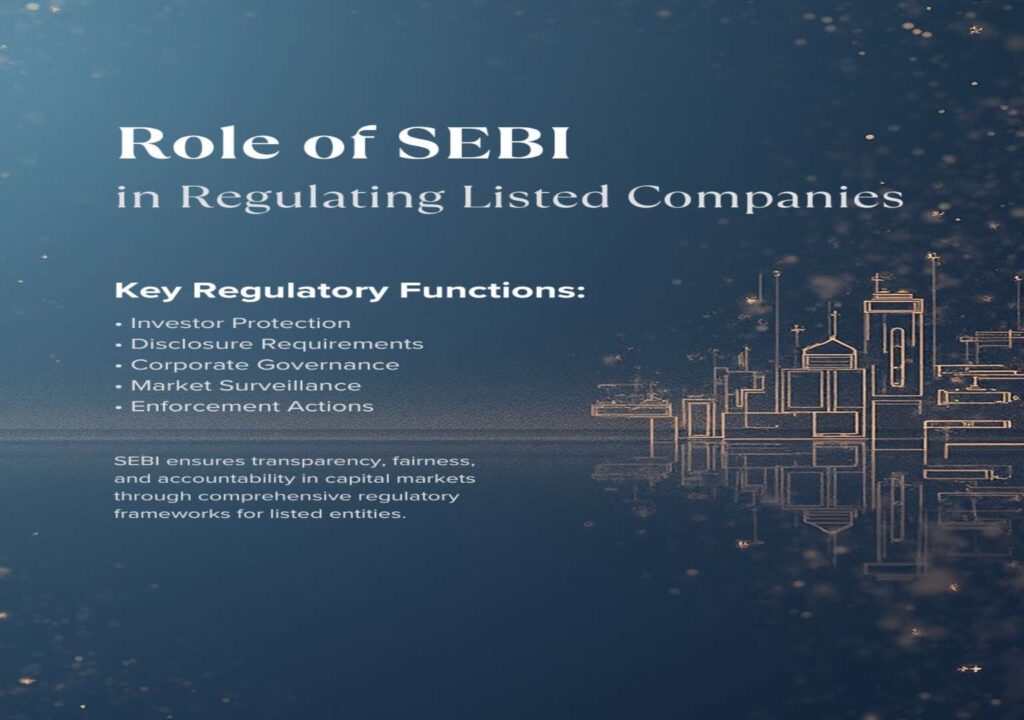
SEBI is India’s financial market regulator, put in place to protect investors, maintain fairness, and promote transparency in the securities market. For listed companies, SEBI performs critical functions related to reviewing disclosures for preventing market abuse and strengthening corporate governance.
Till the regulations of SEBI became more robust, many listed companies indulged in delayed disclosures, expensive insider trading, and poor governance policies, ultimately leading to investor confidence loss and frequent market manipulation.
SEBI works as a watchdog to ensure that listed companies maintain strict compliance norms, disclose material information on time, and treat shareholders fairly. This has vastly enhanced corporate transparency and has helped in maintaining relative stability in the financial markets.
This blog explains in simple terms the purpose, powers, regulatory framework, and important judicial precedents relating to SEBI’s regulation of listed companies.
Why SEBI Regulates Listed Companies?
It was empowered to regulate listed companies so that the financial markets of India would remain fair and trustworthy.
Its main tasks are:
- Safeguarding the interests of the investors
- Ensuring transparency and timely disclosures
- Insider trading prevention and market manipulation
- Promote good corporate governance
- To maintain an efficient and stable securities market
- Ensuring companies are in compliance with all listing obligations
Courts have often remarked that “SEBI’s role is to maintain the integrity of the securities market and uphold investor confidence.”
Who Comes Under SEBI’s Regulatory Framework?
SEBI regulates the following entities involved in India’s securities market:
- Listed Companies
All companies whose shares are publicly traded on stock exchanges (NSE/BSE).
- Market Intermediaries
Merchant bankers, brokers, registrars, credit rating agencies etc.
- Market Infrastructure Institutions
Stock exchanges, depositories, clearing corporations.
SEBI ensures that listed companies comply with the Listing Obligations and Disclosure Requirements (LODR), Insider Trading Regulations, and Corporate Governance Standards.
Key Features of SEBI’s Regulation for Listed Companies
- Statutory Disclosures-SEBI LODR Regulations 2015
Publicly listed companies must disclose:
- Financial results
- Shareholding patterns
- Price-sensitive information
- Corporate actions: Dividend, bonus, buyback
- Related-party transactions
Courts have described timely disclosure as “the backbone of investor protection under SEBI law.”
- Corporate Governance Norms
SEBI ensures that companies follow high governance standards:
- Independent directors
- Audit committee
- Vigil mechanism
- Board evaluation
It thus provides safeguards against arbitrary decisions and misuse of the company’s funds.
- Prevention of Insider Trading (SEBI PIT Regulations 2015)
Insider trading occurs when unpublished price-sensitive information is misused.
The following are included in SEBI’s framework:
- Trading window restrictions
- Employees’ Code of Conduct
- Penal actions against violators
Courts have called insider trading “a serious breach of market integrity.”
- Takeover Regulations-SEBI SAST Regulations, 2011
SEBI regulates acquisition and takeover by ensuring that:
- Compulsory open offers
- All shareholders have equal opportunities to exit
- The prevention of hostile and unfair takeovers
- Investigative and Enforcement Powers
SEBI can:
- Conduct inspections
- Summon documents
- Impose fines
- Freeze assets
- Issuance of debarment and disgorgement orders
The Supreme Court has upheld that “SEBI’s powers must be exercised to ensure orderly development of the securities market.”
- Protection Against Fraudulent and Unfair Trade Practices (FUTP Regulations)
These regulations prevent:
- Price manipulation
- Statements that are not true
- Circular trading
- Pump-and-dump schemes
How SEBI Ensures Compliance (Step-by-Step)
Step 1: Monitoring the Disclosures
SEBI and stock exchanges continuously monitor the announcements made by the listed companies.
Step 2: Anomaly Detection
Unusual trading patterns or complaints trigger an examination.
Step 3: Investigation
The following aspects may be scrutinized by SEBI:
- Emails
- Call records
- Board minutes
- Company documents
- Market data
It can also perform forensic audits.
Step 4: Show Cause Notice
The company or individuals must explain alleged violations.
Step 5: Final Order
SEBI may:
- Impose economic sanctions
- Shut people out from marketplaces
- Direct corrective disclosures
- Order return of illegal gains
Courts emphasize that “SEBI must act decisively to prevent market distortion.”
Landmark Judicial Decisions on SEBI’s Role
- Sahara India Real Estate Corp. Ltd. v. SEBI (2012)
The Supreme Court upheld SEBI’s authority to regulate illegal fund-raising through OFCDs.
Held that SEBI can intervene whenever investor interest is at stake.
- SEBI v. Kishore R. Ajmera (2016)
Held that market manipulation can be inferred from conduct and circumstances.
Direct evidence is not always necessary.
- SEBI v. Kanaiyalal Baldevbhai Patel (2017)
Clarified that mere possession of UPSI is enough to establish insider trading.
Strengthened SEBI’s enforcement powers.
- Price Waterhouse (PWC) v. SEBI (2018)
After the Satyam scam, SEBI barred Price Waterhouse for faulty audits.
Upheld SEBI’s authority to act against entities aiding fraud, not just companies.
- Reliance Industries Ltd. Futures Manipulation Case (2021)
SEBI imposed major penalties on RIL.
SAT upheld SEBI’s strict stance against complex manipulation schemes.
Practical Challenges in SEBI Regulation
- Complexity of data leading to delayed investigations
- Insider trading cases based on circumstantial evidence
- Fast changes in trading patterns due to rapid technological changes
- Cross-border transactions
- The need for faster adjudication
- Rise in the number of market participants
Tips for Listed Companies to Ensure SEBI Compliance
- Make all disclosures on time and accurately
- Ensure good corporate governance
- Educate employees about insider trading rules
- Hold transparent communication with shareholders
- Keep related-party transactions properly documented
- Obtain legal advice for key corporate decisions
Conclusion
SEBI is important in facilitating transparency, equity, and integrity within the securities market. SEBI protects investor interests through the regulation of listed companies, monitoring disclosures, preventing insider trading, and enforcing corporate governance norms in order to strengthen India’s financial ecosystem. Companies involved in the cases pertaining to compliance issues, allegations of insider trading, or investigations by SEBI should seek services from professionals such as Advocate Noor Yaqoob Shaikh, with expertise in securities laws, corporate governance, and regulatory litigation.