
Difference Between Testamentary Succession and Intestate Succession
- February 03, 2026
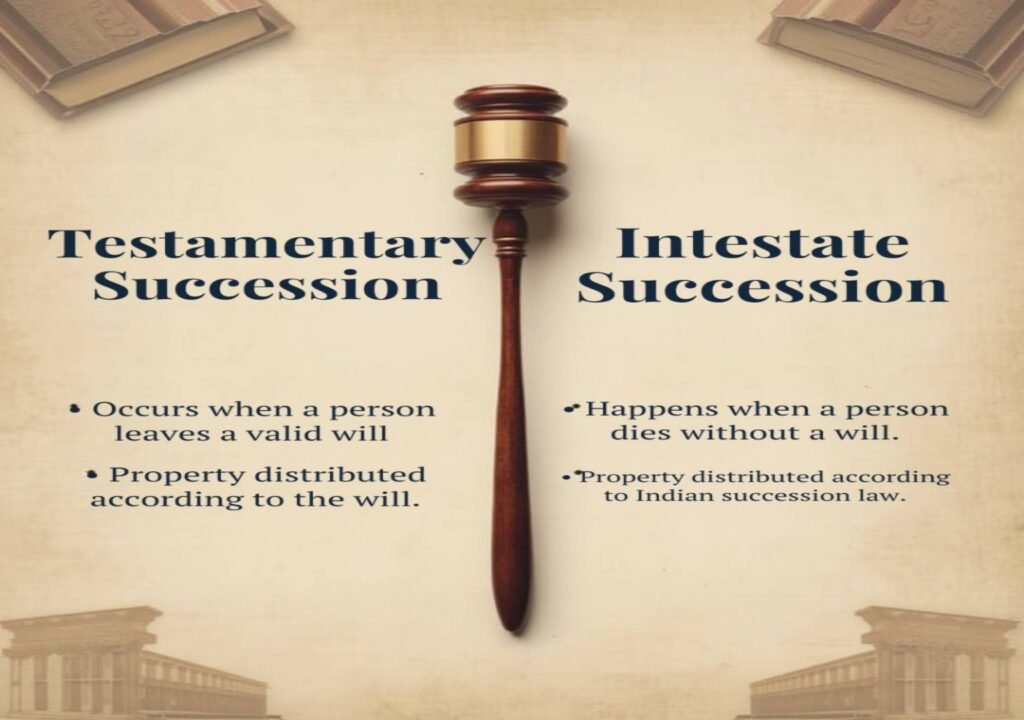
Succession refers to the passing on of a deceased person’s property, rights, and liabilities upon their death. In India, this field of law determines significantly how a deceased’s property gets divided among relatives. According to law, there are two broad types of succession: testamentary and intestate.
Knowing these two types of succession enables people to plan their estates effectively and avoids unwanted family conflicts. Both concepts are explained in this article, their differences emphasized, as well as how Indian courts construe them.
Why Knowing Succession Laws Is Essential
- Prevents Family Conflicts: A good succession plan avoids disputes regarding inheritance.
- Clarity in the Law: Guarantees distribution of property according to the will of the person or according to the law.
- Financial Security: Ensures dependents understand their rightful entitlement in assets.
- Easy Transfer of Assets: Facilitates the legal process upon the death of the owner.
- Tax and Compliance Advantages: Planned estates according to succession laws can minimize economic and legal issues.
What Is Testamentary Succession
Testamentary succession takes place when an individual passes away after leaving behind a valid will. A will is a lawful statement of an individual’s desire regarding the disposal of their property upon death.
Testamentary succession important characteristics:
- The deceased individual communicates his wishes in writing, referred to as a will.
- The property is divided as per the instructions provided in the will.
- It leaves the individual totally free to decide on beneficiaries, i.e., friends, relatives, or even charities.
- The will has to satisfy the Indian Succession Act, 1925 formalities like valid signature, witness, and soundness of mind of the testator (the individual who is making the will).
If Mr. Arjun writes in his will that his house will go to his daughter and his bank savings to a charity, this is testamentary succession. After his death, the executor named in the will ensures that his directions are followed.
What Is Intestate Succession
Intestate succession arises when an individual passes away without a valid will. The property is then distributed under the personal laws governing the deceased individual in such a situation.
Pivotal aspects of intestate succession:
- The deceased person did not create a will, or the will cannot be relied upon.
- The property is partitioned according to succession laws only.
- The law determines the heirs and their share.
- Hindus, Muslims, Christians, and Parsis have a different process in accordance with their personal laws.
Example:
If Mrs. Meena passes away without leaving a will, her property will be bequeathed to her legal heirs (husband, children, and mother) in terms of the Hindu Succession Act, 1956.
Legal Framework for Succession in India
Indian Succession Act, 1925
- Regulates testamentary succession in case of Christians, Parsis, and others.
- Sets rules of making, revocation, and operation of wills.
Hindu Succession Act, 1956 (applicable to Hindus, Buddhists, Jains, Sikhs)
- Regulates intestate succession in the event of death of a Hindu intestate.
- Prescribes Class I and Class II heirs and their respective shares.
Muslim Law (follows Shariat principles)
- Does not adopt the Indian Succession Act.
- Conforms to Quranic laws: an individual may will away only a third of their property; the remaining portion devolves on legal heirs according to Islamic inheritance laws.
Special Marriage Act, 1954
- If two people get married through this Act, their succession of property is governed by the Indian Succession Act, 1925, regardless of their religion.
Differences Between Testamentary and Intestate Succession

Judicial Observations on Succession
Kanta Yadav v. Om Prakash Yadav (2017, Delhi High Court)
The Court held that a valid will prevails over natural succession. Once there is testamentary succession, the laws of intestacy do not come into play.
Gopal Krishnaji Ketkar v. Mohamed Haji Latif (1968, Supreme Court)
The Court laid stress upon the fact that when a person creates a will, it should be done with free consent, free from fraud, coercion, and undue influence.
Kanta Devi v. Union of India (2021, Delhi HC)
The Court held that if an intestate person expires, successors are required to establish their relationship legally to inherit property under a succession certificate.
Mohammed Raza v. Abbas Bandi Bibi (1932, Privy Council)
The Court held that according to Muslim law, a will (wasiyat) cannot distribute more than one-third of the estate against the wishes of the legal heirs.
Practical Challenges in Succession Cases
- Conflicts Over Validity of Will: Heirs will often challenge the validity of the will or question the mental state of the testator.
- Absence of Documentation: Missing property documents or ambiguous titles make both testamentary and intestate proceedings difficult.
- Delay in Probate or Succession Certificate: Judicial processes take time, resulting in delayed inheritance.
- Disputes Within the Family: Conflict between siblings or relatives regarding the share of property is frequent.
- Legal Expenses: Probate or legal expenses can lower the value of inherited assets.
- Shifting Family Arrangements: Remarriage, stepchildren, or blended family arrangements complicate the property division.
Steps to Ensure Smooth Succession
Make a Valid Will:
Clearly express your wishes and specify all beneficiaries.
Name an Executor:
Choose a reliable individual to carry out the will upon your demise.
Regularly Update the Will:
Install a new executor and make changes if there are any modifications.
Revise the will in case of significant life events like marriage, child birth, or property
acquisition.
Maintain Proper Documentation:
Store property documents, bank statements, and identification documents securely but within reach.
Seek Legal Advice:
Having a lawyer review your will ensures your will is lawful and minimizes opportunities for conflict.
Conclusion
Understanding the difference between testamentary succession and intestate succession is vital for anyone who owns property or has dependents. Testamentary succession allows an individual to decide how their assets will be distributed after death, while intestate succession relies entirely on legal rules and personal laws.
Creating a sound will not only brings peace of mind but also spares loved ones from legal war and emotional agony. All individuals, young or old, and rich or poor, should plan their estate in advance.
For legal support regarding will drafting or succession matters, you may connect with Advocate Noor Yaqoob Shaikh.