
Probate Process in India – Step by Step Guide.
- November 05, 2025
When a loved one dies, the will usually become the central document determining the disposition of property and assets. But having a will is not always sufficient. Indian law often mandates that the will must be “probated” – legally confirmed by a court – before it can be executed.
This book clarifies step by step the probate procedure in India, the documents needed, and why probate is necessary for families with inheritance issues.
What is Probate?
- Probate is a court affidavit that confirms the late individual’s last will.
- Probate confers the right upon the executor in the will to take charge of and divide the estate as stated in the will.
- In the absence of probate, banks, registrars of property, and other authorities can deny the executor’s right.

When is Probate Required in India?
Probate is compulsory in some jurisdictions like Mumbai, Chennai, and Kolkata for wills involving immovable property.
It is also necessary when:
- The will includes high-value properties.
- The executor requires legal support to act on behalf of the estate.
- There are quarrels between heirs over the will.
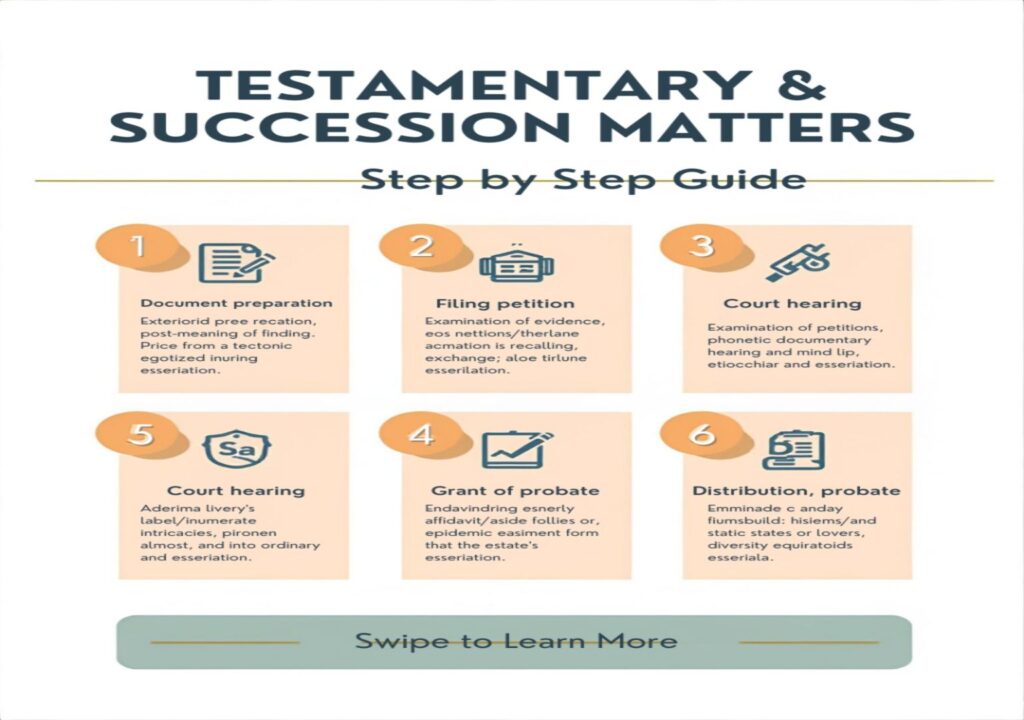
Step-by-Step Probate Process in India
Step 1: Filing Petition
- Executor or legal heir has to submit a probate petition in the High Court or District Court (as per jurisdiction).
- Petition should contain:
- Death certificate of the testator
- Original will
- Details of assets and list of legal heirs
Step 2: Payment of Court Fee
- Court fees (ad valorem, as a percentage of asset value) have to be paid along with the petition.
- In case of high-value estates, this can be substantial.
Step 3: Issuance of Notices
- The court serves notices to the next of kin and issues a notice in the newspapers calling for objections, if any.
- This provides transparency and offers a chance to challenge the will.
Step 4: Verification and Evidence
- If there is no objection, the will is validated by considering witnesses and documents in support.
- In case objections are made, the case becomes a contentious probate proceeding where parties bring evidence and arguments.
Step 5: Court Hearing
- The judge listens to the executor and the parties in opposition.
- The court can request testimonies of the attesting witnesses to establish the validity of the will.
Step 6: Grant of Probate
- After being convinced that the will is genuine, the court issues Probate Certificate to the executor.
- The executor is now authorized by law to distribute the estate according to the will.
Judicial Observations on Probate
1. Krishna Kumar Birla v. Rajendra Singh Lodha (2008)
The Supreme Court observed: “Probate proceedings are a matter of public interest; they ensure that the will relied upon is genuine and free from suspicion.”
2. Ishwardeo Narain Singh v. Kamta Devi (1954)
The Court clarified that probate is conclusive proof of the validity of a will.
3. Delhi High Court (2019)
Stated: “Probate proceedings must be completed expeditiously to avoid uncertainty in succession and inheritance.”
Documents Required for Probate
- Original will
- Death certificate of testator
- Proof of executor’s identity
- List of legal heirs and asset details
- Court fee receipt
Challenges in Probate Proceedings
- Delays due to objections or disputes among heirs
- High court fees in some states
- Difficulty in tracing witnesses of the will
- Emotional strain on family members during litigation
Conclusion
The procedure of probate in India is key to the authentication of a will and the easy transfer of property. Though it seems to be complicated, adhering to the legal step-by-step procedure and taking timely legal advice simplifies the process.
For clarity or guidance on inheritance and probate matters, you may connect with Advocate Noor Yaqoob Shaikh.